|
The origin of the first settlers of
the Maldives still remains a mystery.
The historians date early settlers back
to 5th century BC with the Aryan immigrants
coming from the neighbouring countries
India and Sri Lanka. The Maldivian language
is said to be Indo-Aryan with influences
from Sinhalese, Tamil, Sanskrit, Persian,
Urdhu and Arabic. It is believed that
Hinduism existed before Buddhism. The
Maldivians were practising Buddhism until
AD 1153, when a learned scholar converted
the king to Islam.
The exact name and origins of this scholar
is an ongoing debate. Some are of the
opinion that he was a Moroccan traveller
named Sheikh. Abul Barakaath Yoosuful
Barubaree. Others say that he was from
Persia and known as Sheikh Yoosuf Shamsudheenul
Thabreyzi. Mr Mohammed Ibrahim Luthufi,
an acclaimed contemporary historian and
researcher, claims that the name of the
person who converted Maldivians to Islam
was Sheikh Aburikaab Yoosuf Thabreyzi.
|
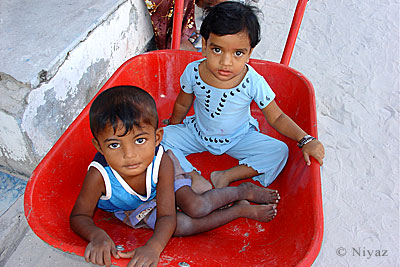
Maldives children,
have proud and a long history |
Since the conversion to Islam, the Maldives
boasts of a recorded history that is rich
and colourful. The system of government
was a monarchy with Sultans as sovereigns
while Sultanas or queens ruled on rare
occasions. Traders from Arabia, India,
Sri Lanka and Persia visited the Maldives
to exchange goods. Slaves were also brought
from Africa. Quite often, sailors were
shipwrecked in the treacherous reefs of
Maldives. These visitors contributed much
to the language and culture of the Maldives.
However, the visitors' influence did not
change the identity of the country as
a secluded haven virtually unknown to
the rest of the world.
The Maldivian culture is rich with flavours
from most of the seafarers who set foot
on its soil. Traditional dances and music
may not be an everyday event but there
are occasions where traditional music
and dances are performed. Though traditional
dresses are not used by present day generation
there are many types of traditional dresses
made for both sexes.
|
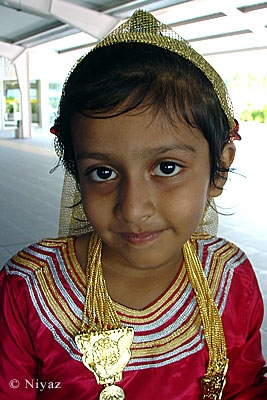
A Maldivian
girl in a traditional dress |
Like the unique geographical formation,
the cultural events and ceremonials are
unique according to the event that is
celebrated or performed. Naming a newborn
child, Bodumaloodhu (a prayer accompanied
with festive meal), Eid festival and circumcision
of male child are few events that take
place where the taste of rich cultural
'cocktail' can be experienced. Bodu beru
(big drum) performanceis the best-known
form of performance of traditional music
and dance where females and males participate.
Bandiyaa (a dance performed by woman),
Thaara (dance performed by male) is among
the top traditional music and dances practiced
in the Maldive Islands.
Traditional food basically fish used
as the main component has been influenced
from the Indian subcontinent. Garudhya
(tuna soup), spicy curry and rice are
the stable food of most of the population.
Most other dishes such as western meals
like pasta are normally modified with
a flavour of tuna in it when prepared
for local consumption. Other meats and
chicken are normally eaten in special
occasions.
|