|
The sea covers 99% of the Maldives and
inside its blue depths lies the mysteries
and riddles related to the formation
of the Maldives.
Charles
Darwin's theory
Maldives is formed when submerged volcanoes rise from the sea, a coral
reef grew on its edge. When the volcanoes submerged, the coral reefs
encircling a water-filled basin remained. Consequently, islands were
formed |
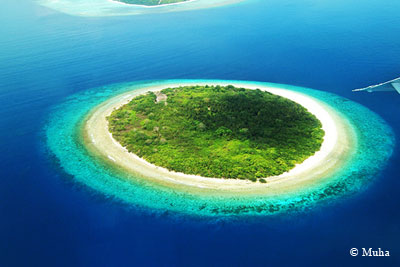
The islands are formed around
a
ring shaped coral reef encircling
a lagoon. This reef structure, typical of
Maldives,
is called an atoll. In fact, the
English word 'atoll' itself is derived from
the
Maldivian or dhivehi word for it-atholhu.
There are
26 natural atolls in the Maldives.
|
Maldives - Islands
are just few feets above sea level |
There are still ongoing debates about the
formation of atolls. According to Charles
Darwin's theory, when submerged volcanoes
rise from the sea, a coral reef grew on its
edge. When the volcanoes submerged, the coral
reefs encircling a water-filled basin remained.
Consequently, islands were formed on the
reefs as the tides and currents brought dead
coral onto sandbars. These were in turn colonised
by plants.
A different view has been provided by Hans
Hass. According to him, layers of coral reefs
might have built up on top of the submerged
mountains until they rose to the surface.
The hardest and highest corals remained while
the weaker corals in the center of the coral
platforms broke down. The remaining corals
at the outer edges formed rings that were
to form the outer rims of atolls. Islands
were formed as debris and sand accumulated
on to the remaining reefs.
The reef is cut by deep channels, which
the locals have mastered to navigate. Protective
reefs safeguard the islands from the elements.
However, the islands are susceptible to erosion.
The islands are low-lying; emerging almost
two meters above the sea level. It is frequent
that one part of the island to erode while
onto another part the currents and tides
deposit sand expanding the island. Over the
course of time, some islands may erode completely,
while others may be formed gradually on a
sandbank. There are still many islands and
sandbanks at various stages of formation.
Hence, the Maldives is a dynamic country
in the making.
Six inches deep humus forms the initial
layers of the soil. Sandstone of about 2
feet is found below and after it sand is
accompanied with fresh water. The salinity
of the soil along the beach restricts the
growth to few plants. Normally, shrubs and
small hedges occupy the area. More inwards,
banyan, mangroves, screwpine and other lush
vegetation are found. For the coconut palms
there seems to be no restrictions. It is
found almost everywhere and have contributed
significantly to the local lifestyle, even
earning the status of the national tree.
While vegetation in the islands is limited,
it is supplemented by the riches of the sea;
varieties of corals, abundant colourful fish
and other organisms that makes the Maldives
'the home of the children of the sea'. |